How to Deflicker a Time-Lapse on Mac?

Have you ever created a time-lapse only to discover distracting flashes or brightness changes in the final video? This effect is known as time-lapse flicker.
Even small exposure differences between consecutive photos can become highly visible when hundreds of images are played rapidly as a video.
In this guide, we'll explain how to remove flicker from a time-lapse on Mac using GlueMotion, preview the correction, and export either the finished video or the corrected images.
What Causes Flicker in a Time-Lapse?
Time-lapse flicker usually appears when the brightness of consecutive photographs isn't perfectly consistent.
Small exposure variations that are almost invisible when looking at individual photos can become obvious once those images are displayed rapidly as video frames.
Flicker can be caused by several factors, including changes in ambient light, automatic exposure adjustments, or small exposure differences between individual photographs.
The result is a time-lapse that appears to flash or pulse instead of transitioning smoothly.
How Does Time-Lapse Deflickering Work?
Deflickering analyzes brightness changes across a sequence of images and applies corrections to make the transitions between frames smoother.
Instead of manually adjusting hundreds or thousands of photographs, GlueMotion can analyze the complete sequence and calculate the corrections automatically.
GlueMotion can then use those corrections to:
- Create the final time-lapse video
- Export corrected images
- Export deflicker values for use in another workflow
Step 1: Import Your Time-Lapse Photos
Open GlueMotion and import the folder containing your time-lapse photo sequence.
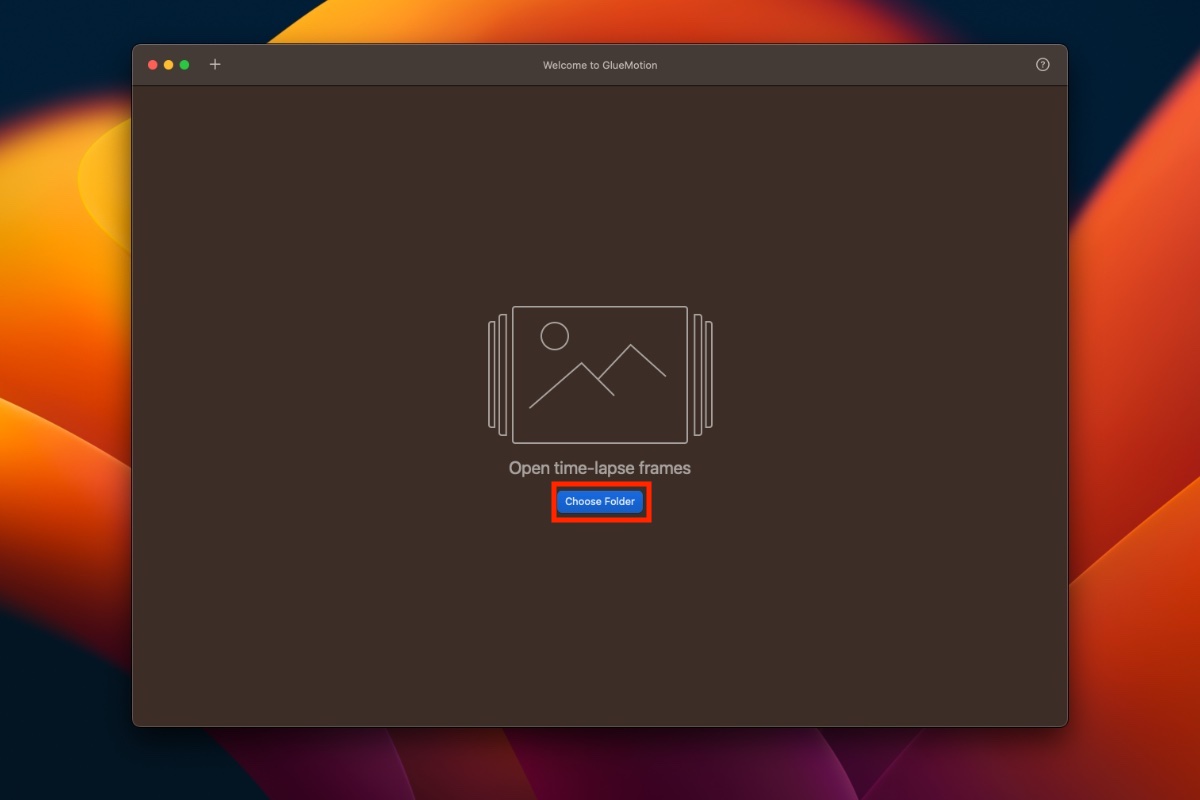
Make sure your images are correctly ordered before continuing through the time-lapse workflow.
Step 2: Configure the Deflickering Settings
Continue to the Deflicker step.
GlueMotion analyzes your photo sequence and displays its brightness variations as a curve.

You can then configure several parameters.
Deflickering Method
This determines how GlueMotion corrects brightness variations across the image sequence.
For most time-lapses, luminance correction is a good starting point and provides a natural-looking correction.
Number of Passes
The number of passes determines how many times the deflickering process is applied.
Typically, one or two passes are sufficient. Increasing the number of passes can produce smoother brightness transitions, but you should use the preview to determine what works best for your sequence.
Window Size
The window size controls how many neighboring frames are considered when smoothing brightness variations.
For example, with a 30-frame window in a time-lapse exported at 60 fps, the window represents approximately half a second of the final video.
A larger window generally produces broader, smoother corrections, while a smaller window follows shorter-term brightness variations more closely.
Use the brightness curve and preview to find settings that work well for your sequence.
Step 3: Preview the Deflickered Time-Lapse
Once you've configured the deflickering parameters, continue to the preview step.
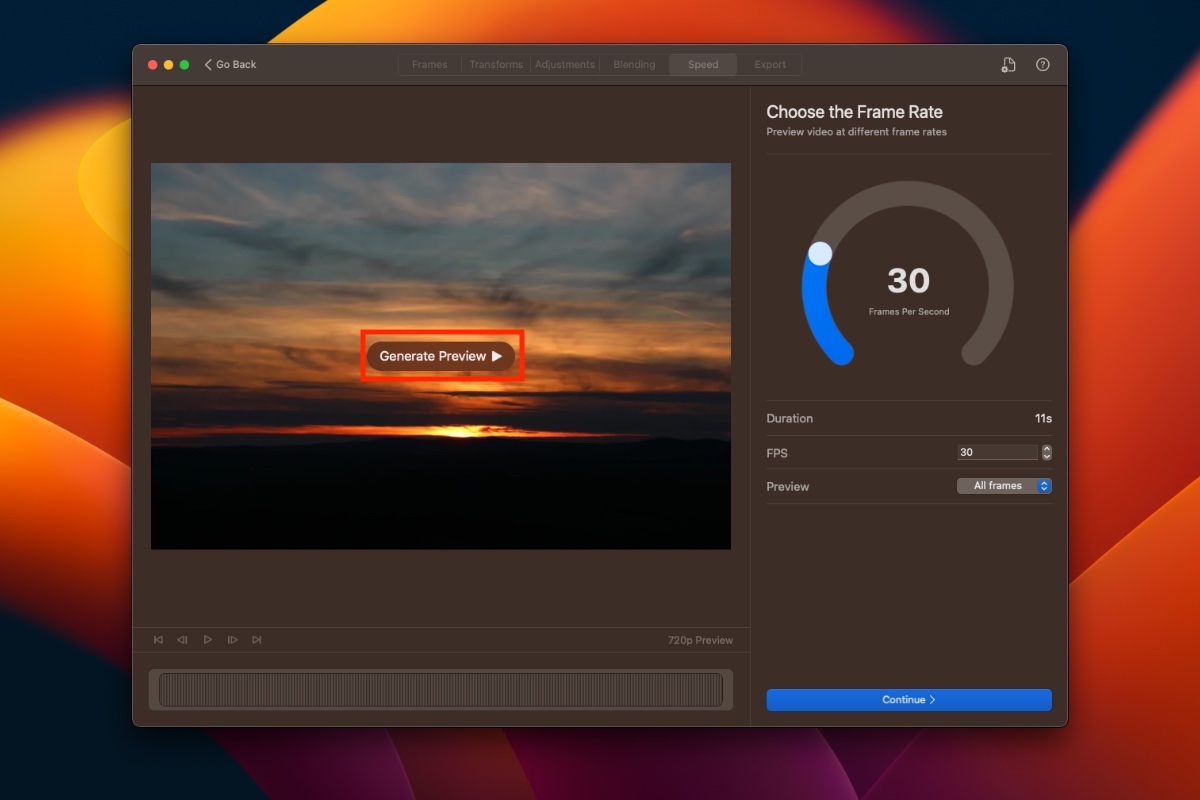
GlueMotion lets you generate a preview before performing the final export.
Look for unwanted flashes or sudden brightness changes. If the result isn't smooth enough, return to the deflickering settings and adjust the parameters.
This lets you experiment without repeatedly encoding the complete final time-lapse.
Step 4: Export the Deflickered Images or Video
Once you're satisfied with the result, GlueMotion gives you several export options.
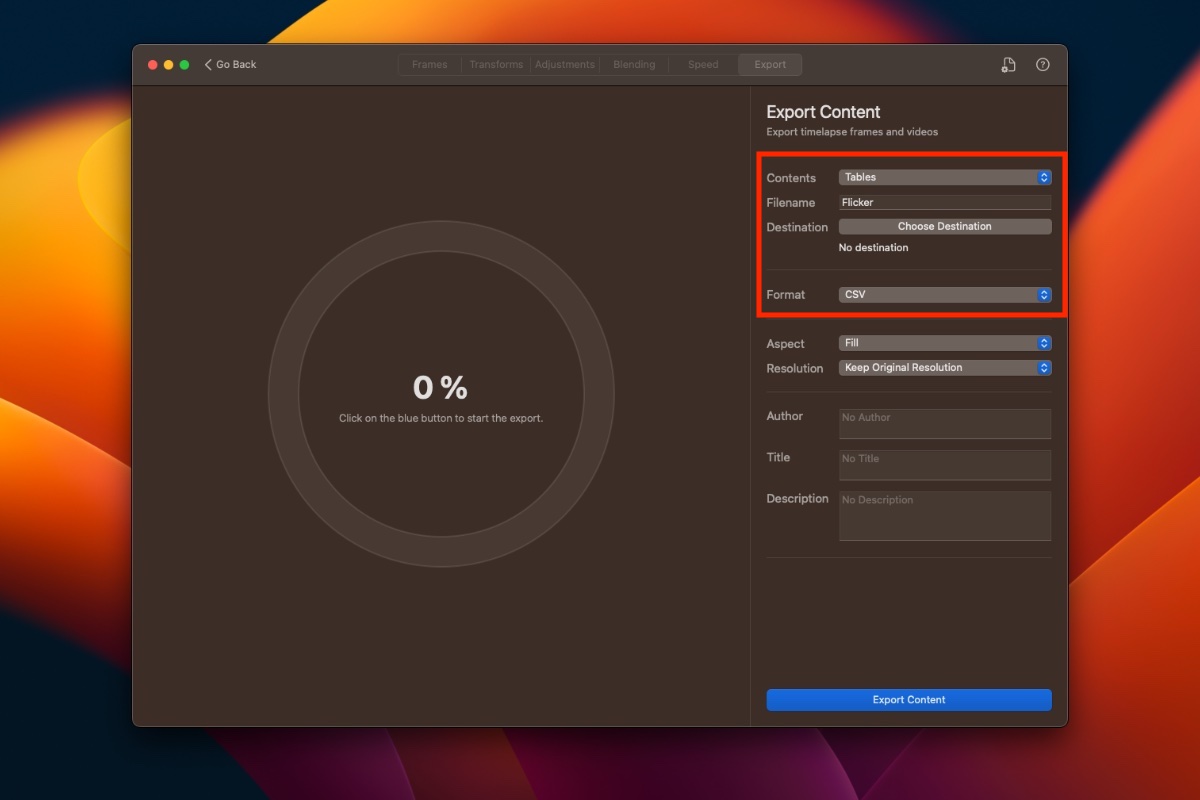
You can export:
- The finished time-lapse video
- The individual images with the corrections applied
- The calculated deflicker values as a CSV file
Exporting corrected images is particularly useful if you want to use GlueMotion only for the deflickering stage and finish your time-lapse in another video-editing application.
Once you've selected the desired output, start the export and wait for processing to complete.

Can You Deflicker Photos Without Creating the Video in GlueMotion?
Yes. You don't have to use GlueMotion to encode your final time-lapse.
You can use GlueMotion to analyze and deflicker your photo sequence, export the corrected images, and then import those images into another application for editing or video creation.
This makes GlueMotion useful as either a complete time-lapse workflow or a dedicated deflickering step in a larger production workflow.
Create Smooth Time-Lapses with GlueMotion
GlueMotion is a time-lapse application for Mac that combines photo sequence management, batch image processing, deflickering, previewing, and video encoding.
Its deflickering tools are designed to reduce unwanted brightness variations across large image sequences without requiring you to manually correct every photograph.
If you regularly create time-lapses from hundreds or thousands of photos, you can use GlueMotion to analyze the sequence, smooth exposure changes, and export either the corrected images or the finished video.
Stay in touch
We are working on awesome new projects, subscribe to be notified.